


Hello and welcome back to The Valleys Lead.
It’s the start of the autumnal flood season, and for residents of Llanhilleth, heavy rain has become a source of fear after Storm Bert flooded homes in November 2024, just four years after Storm Dennis. Although new flood protections are being introduced, residents say it will take time before they feel safe again. One resident told The Valleys Lead she is relieved that action is being taken but angry that residents had to fight so hard to get there.
The story is below (and free to read today!) - but just quickly - we’d love you to support The Valleys Lead.
There isn’t another publication doing what we are in the south Wales valleys - covering stories from all these valleys, going behind the headlines to report on stories that matter to locals, asking questions of people in power, and speaking with real people in the valleys about their opinions and experiences.
This kind of journalism takes time and effort, and we’d love your support to keep reporting about stories that need to be heard.
You can support us by simply subscribing via free and paid options. You’ll get to read two newsletters a week from us. Each edition has three very brief news updates from the south Wales valleys, and a slightly longer-length story.
Simply type your email and that’s done! Or email laurencrosbymedlicott@gmail.com and she’ll get you signed up.
We also always want to hear what is happening in your valley, your town, your village (seriously! no story is too small). Please email laurencrosbymedlicott@gmail.com with anything you feel we should cover.
The Valleys Briefing
(A little round-up of some stories in brief from our valleys. Anytime you have something you’d like to share, no matter how big or small, email laurencrosbymedlicott@gmail.com):
On Monday, Prime Minister Andy Burnham visited Aberfan ahead of the the 60th anniversary of the Aberfan disaster. Today, the King, Queen, and Prince of Wales will visit the village to meet survivors, bereaved parents, siblings, and former pupils. In the days following the media attention on Aberfan, The Valleys Lead will be asking residents what they want to see done to support their village and what must be done to ensure that a similar disaster doesn’t happen elsewhere. Please email laurencrosbymedlicott@gmail.com if you’d like to discuss this.
Seventeen museums, archives and libraries projects across Wales are to benefit from additional funding - helping to deliver on the Welsh Government's Programme for Government commitment to widen access to culture - with over £550,000 being invested in communities across the country. In Blaenau Gwent, the Cultural Library Youth Engagement Partnership will extend the Youth Library Co-ordinator role and expand engagement with under-represented young people. Merthyr Tydfil’s Heritage and Herstories Digital Museums Project will broaden school engagement and heritage trails. Rhondda Cynon Taff will expand public access to its museum and library collections through website development and new digital content. Torfaen, on behalf of Gwent Archives and the Archives & Records Council Wales, will deliver remaining engagement and digital legacy activity under the Archifau Cymru Byw programme. Neath Port Talbot will extend its pop-up museum programme with a new digital heritage platform and expanded community engagement activity.
Carrying on from last week’s story regarding a train line to Abertillery, Senedd Members will discuss a petition this week calling for a feasibility study to reopening Nelson railway station. The petition will be discussed on Thursday afternoon in the Senedd’s Petition Committee, after 416 people signed up.
The petition calls as a first step, to create an express bus service to nearby railway stations. The old Nelson and Llancaiach railway station at Tawelfan opened in 1912 but was closed in 1964. The old track and line still exist near Nelson. Lindsay Whittle MS for Blaenau Gwent Caerffili Rhymni said: “It is more than 60 years since Nelson railway was shut under the Beeching cuts. It was a short-sighted policy that left many communities without a railway. I fully support a feasibility study aimed at eventually reopening the station. The old track and line still exist near Nelson making its reopening a lot easier. We need to provide the services so that people can have the opportunity to let the train take the strain, rather than using a car for journeys to work and for leisure. Action is needed now to progress this scheme.”
“We’re holding our breath every time it rains”: Life after the Llanhilleth floods
When Sally Greenwell bought her house in Llanhilleth in 2023, she questioned the estate agent about any ongoing flood risks after learning that the house had been flooded in 2020 during Storm Dennis.
“The agent told me it was a problem that had all been fixed,” Sally told The Valleys Lead.
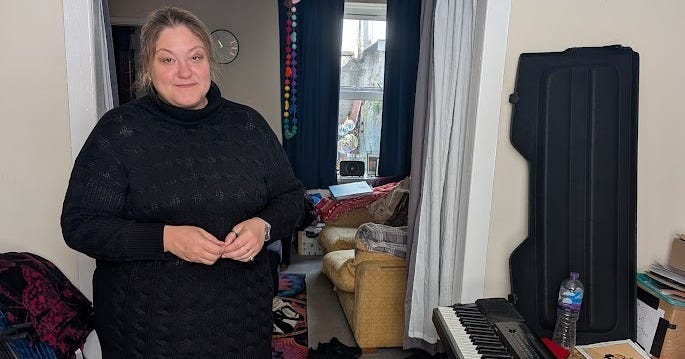
Sally soon discovered, on 24 November 2024, after days of Storm Bert battering the south Wales valleys, that the flooding issue was far from resolved.
“At seven o’clock in the morning, a neighbour was banging on my door saying, ‘It’s happening again’ – she was really distressed,” Sally recalled. “I came outside and could see the water coming up the street slowly. I couldn’t do anything about it.”
She knocked on doors, waking neighbours to alert them. Sally and others in her street spent hours trying to move the water away from their homes with brooms and buckets, barricading their doorways with towels to keep the water out.
“We were desperate,” Sally said. “It was really upsetting, and it was chaos for hours.”
Sally called the emergency services for assistance but was told Llanhilleth “wasn’t a priority”.
“I told them there were quite vulnerable residents on the street, but they just kept asking if I was in danger,” she said.
Four hours later, the fire brigade arrived, pumping water away from residents’ homes.
In the days following the flooding, Helen Cunningham, Independent Councillor for Llanhilleth, told The Valleys Lead that residents were “shocked, devastated, and angry”.
Only four years earlier, houses in Llanhilleth had been flooded during Storm Dennis, and residents felt nothing had been done to prevent it from happening again.
“There were some whose homes hadn’t recovered from the last lot of flooding,” Cunningham told The Valleys Lead. “I was speaking to residents who still hadn’t fully replaced what had been lost and damaged back in 2020. I remember standing with a resident in a state of shock, up to our knees in water in her living room and wading through another person’s kitchen. You don’t ever forget stuff like that – it stays with you.”
Cunningham said that following the 2024 flooding, residents in the street were terrified every time it rained.
“After Storm Bert, anxious and distressed residents would be calling and messaging me whenever there was heavy and prolonged rain,” she said.
Kay Corbett, an elderly woman living a street away from Sally, told The Valleys Lead that she has been checking for water ingress whenever it rains since her house was flooded during Storm Bert.
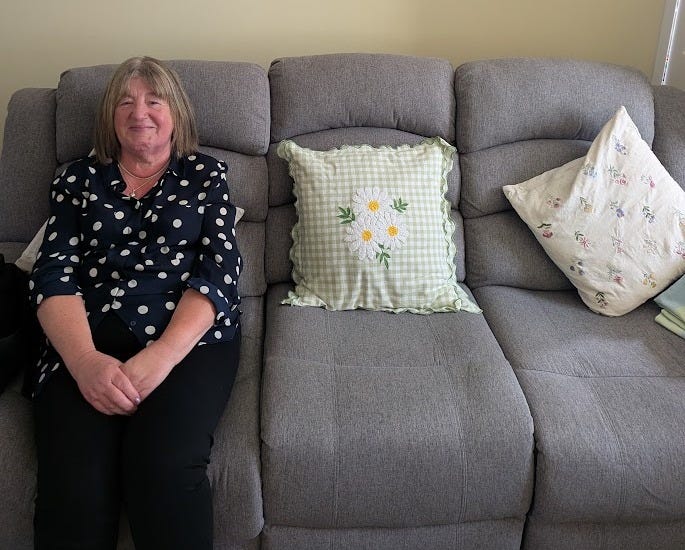
She had only just completed repairs to her house following the flooding during Storm Dennis when, in November 2024, she woke to find water coming in again through the back door.
“You couldn’t stop it,” she said.
This time, she was “angry” because “nothing had been done to prevent it happening again”.
“I was annoyed,” she said. “My insurance has gone right up now. It’s gone from £700 to £1,000.”
Once again, she had to make way for builders to strip out her house and repair the water damage.
“I lived upstairs while all the work was being done,” she said.
Determined to ensure the flooding did not happen on the same scale again, Sally began reviewing reports related to the 2020 flooding with the help of a water engineer.
“There were massive screw-ups,” Sally said.
She tried to raise her concerns with Blaenau Gwent County Borough Council but felt unheard.
“I felt I was hated for asking questions,” she said.
Two years after the flooding, Sally’s questions and Cunningham’s advocacy on behalf of residents have helped bring about action.
“After the 2024 flooding, I was determined that residents’ concerns and experiences were listened to and taken seriously,” Cunningham said. “I fought for a review to understand what had happened and ensure everything humanly possible was done to prevent it from happening again. That wasn’t easy. It was probably one of the most challenging and eye-opening things I’ve experienced. One councillor referred to my efforts as a ‘f***ing waste of time’.
“But on the flip side, responses from key senior officers in the council were absolutely outstanding. They met with residents a number of times in 2025 and were 100% committed to listening, learning and getting it right. They walked the streets that had been flooded and visited flooded residents in their homes and helped drive all the changes that have happened since.”
On the day The Valleys Lead visited Llanhilleth, engineers were knocking on doors in preparation for installing floodgates and non-return valves in homes susceptible to flooding.
Cunningham said the Council had increased the capacity of the culvert – “a big piece of work” – and that its outflow had been angled to help discharge water into the river. A non-return valve had also been installed to prevent water from flowing back into the system when the river was high.
A spokesperson for Blaenau Gwent County Borough Council told The Valleys Lead that its first priority had been repairing and upgrading the damaged culvert mentioned by Cunningham. The council then worked with Welsh Water to “ensure they fully inspect their apparatus in the area, namely the pumps, which uncovered an issue with debris which has been subsequently removed”.
“On top of this, we are currently undertaking detailed CCTV surveys of all the drainage in the area of the fields together with emptying the gullies,” the spokesperson said. “Working with the community on flood resilience, we have purchased an additional pump for this location and provided Floodsax which are kept in the miner’s institute for rapid deployment.”
A property-level protection scheme is also being rolled out, with fully funded floodgates offered to 82 properties in July.
“It was hoped to commence work on this in September; however, only 35 properties replied, so we are still appealing to residents who are yet to reply to do so quickly, so the work can be scheduled to start in November,” the spokesperson said.
The range of measures shows that the Council “has taken the 2024 flooding seriously” and “responded to it not just with one measure, but with several that each address the different aspects of the flooding”, Cunningham said.


Kay is grateful for everything that has been done, and will be done, to prevent future flooding, but she is not allowing her hopes to get too high.
“They can’t stop it coming in,” she said. “It’s reassuring [that mitigation is being put in place], but that water will find a way. I’m just waiting to see what happens. But it won’t stop any of us being nervous every time it rains.”
Sally also acknowledged the Council’s efforts but said “it shouldn’t have been a battle like this” to get flood mitigation in place.
“I’m really pleased they’ve eventually done all this,” she concluded. “I’m just still angry and upset because it shouldn’t have taken all this to get the work done.”