


Hello and welcome back to The Valleys Lead.
More than a century after it was first built, Abertillery's historic Stute could once again become a place for local people to come together. But after a decade of campaigning, those fighting to save the building still face one major obstacle: securing the £3 million needed to bring it back to life.
The story (a historic one with lots of photos!) is below - but just quickly - we’d love you to support The Valleys Lead.
There isn’t another publication doing what we are in the south Wales valleys - covering stories from all these valleys, going behind the headlines to report on stories that matter to locals, asking questions of people in power, and speaking with real people in the valleys about their opinions and experiences.
This kind of journalism takes time and effort, and we’d love your support to keep reporting about stories that need to be heard.
You can support us by simply subscribing via free and paid options. You’ll get to read two newsletters a week from us. Each edition has three very brief news updates from the south Wales valleys, and a slightly longer-length story.
Simply type your email and that’s done! Or email laurencrosbymedlicott@gmail.com and she’ll get you signed up.
We also always want to hear what is happening in your valley, your town, your village (seriously! no story is too small). Please email laurencrosbymedlicott@gmail.com with anything you feel we should cover.
The Valleys Briefing
(A little round-up of some stories in brief from our valleys. Anytime you have something you’d like to share, no matter how big or small, email laurencrosbymedlicott@gmail.com):
Vulnerable residents in Caerphilly county are waiting more than seven-and-a-half months for vital adaptations to their homes and that must be cut, say Plaid Cymru councillors. In a report to Caerphilly Council, Audit Wales warned that having to wait a long time for a housing adaptation may mean people being unable to do daily tasks. Delays may also increase the risks of falls, leading to the need to access other public services, auditors warned. New Hengoed councillor Anthony Cook, who is a member of the authority’s housing and environment scrutiny committee which received the report, said: “As a compassionate and caring society, we have a fundamental duty to look after our elderly residents and those with mobility issues. I have seen first hand how people struggling with mobility are left waiting far too long for critical adaptations to their homes, which negatively affects their independence, dignity, and everyday lives. The improvements in waiting times are welcome. However, an average wait of over seven months is still far too long. A wait of that length could possibly feel like an eternity for somebody struggling to live independently in their own home. More must be done to reduce these waiting times.” Charlotte Bishop, leader of the Plaid Cymru group, said: “We acknowledge improvements have been made in reducing waiting times from an average of 473 days to 229 days in 2025-26 but that is still far too long. We’re talking about people’s dignity, independence and wellbeing. These delays can leave people struggling with everyday tasks and increase the risk of falls, which ultimately puts more pressure on our NHS and social care services. The Council must put its full focus on reducing those waiting times further which will improve the quality of life for many people.”
New research from Crisis reveals the ten affordable housing deserts in Great Britain, where not a single property listed in the last year is affordable for people in receipt of Local Housing Allowance (LHA), sometimes known as housing benefit. Analysis by Crisis of data from the charity's partner Zoopla shows that in ten areas there wasn't a single newly listed property which a person on housing benefit could afford. They are: Brentwood, Dartford, Melton Mowbray, Renfrewshire, Ribble Valley, South Hams, Staffordshire Moorlands, Warrington and Wrexham. Finally, as concerns us in the south Wales valleys, Merthyr Tydfil was listed as one of the ten places in the UK where there wasn’t a single property listed in the last year which was considered affordable by someone on housing benefit.
In Rhondda Cynon Taf, residents are being encouraged to recycle more as Council launches its latest "Recycling in RCT is Seriously Easy" campaign, featuring a number of changes that make recycling simpler than ever before. The biggest change is the introduction of accepted soft plastics into the Council’s Clear Bag recycling service. That means all those plastic bags and wrappings can now be placed into your clear recycling bags. From now on, residents can recycle a range of accepted soft plastic items through their regular kerbside collection, alongside paper, cardboard, cans, cartons, bottles and jars. The Council has also made it easier to recycle paper, with paper no longer needing to be separated into its own bag.
“We want the phoenix to rise again”: The fight to save Abertillery’s historic Stute
Well over a century ago, in 1898, the Powell’s Tillery Institute, later known as the
Abertillery Workmen’s Welfare Institute, opened as a place for people in the community, primarily men, to socialise, relax, swim and receive an education.
The 720-square-metre building was expansive, featuring an 18-metre swimming pool and several committee rooms and halls, which could accommodate up to 200 people.
It was also used for overflow Sunday services during the Christian revival that swept across Wales in the early 1900s, and provided a space for local workmen to discuss and develop their ideas on trade unionism.
Following a devastating fire in 1951, the Institute, affectionately nicknamed The Stute, was rebuilt. Miners contributed money from their weekly wages to fund its replacement, which reopened in 1955.
During the miners’ strike in 1984, Julie Holt told The Valleys Lead that her family friend, Pearl Williams, organised a women’s support group from the building.
“Women weren’t allowed in the Stute previously, but she made sure they could come in then,” Holt, a resident hoping to get the Stute reopened, said. “She ran a soup kitchen and food collection point in here.”


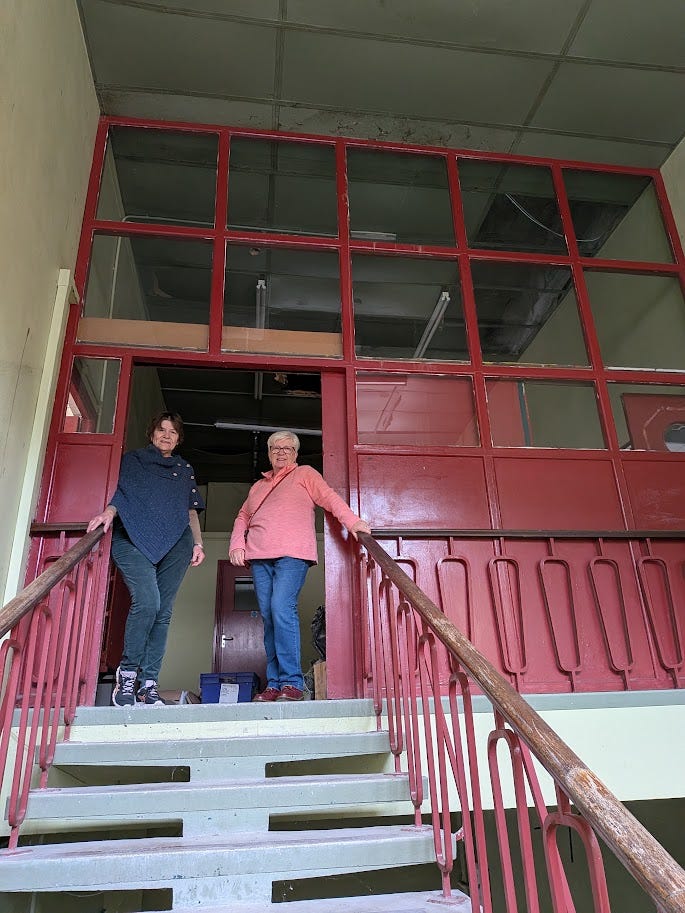
But over the years, the building fell into disrepair after being largely unused since 2010. It eventually closed and was sold in 2016.
When The Valleys Lead visited the site, financial ledgers remained on desks in the former office, while historical documents and untouched notes lay tucked away in drawers.
Holt is one of nine trustees behind Save Our Stute Abertillery, a group that has spent more than a decade fighting to secure the funding needed to bring the historic building back into use.


“The history in this building is immense,” Holt said. “The story of this building is the absolute passion of the community in Abertillery.”
She believes restoring the Stute could bring renewed hope and a sense of community to the town.
“This is an area of high deprivation – 45 per cent of our children in this area are in high levels of poverty,” Holt said. “There is a need for this space.”
