


Hello and welcome back to The Valleys Lead.
More than 20 years after uncovering suspected chemical dumping at sites across the UK, Reverend Paul Cawthorne is taking legal action against Caerphilly Council over its handling of the former Ty Llwyd quarry. He argues that insufficient contamination testing and a lack of transparency underpin the Council’s decision that the site does not meet the legal definition of contaminated land.
The story is below - but just quickly - we’d love you to support The Valleys Lead.
There isn’t another publication doing what we are in the south Wales valleys - covering stories from all these valleys, going behind the headlines to report on stories that matter to locals, asking questions of people in power, and speaking with real people in the valleys about their opinions and experiences.
This kind of journalism takes time and effort (a lot of it!), and we’d love your support to keep reporting about stories that need to be heard.
You can support us by simply subscribing via free and paid options. You’ll get to read two newsletters a week from us. Each edition has three very brief news updates from the south Wales valleys, and a slightly longer-length story.
THIS MONTH ONLY, 50% off of the normal annual subscription cost, because Christmas is coming. Just follow this link to get the deal. You’ll get to read every single piece of work we produce if you choose this option, and you’ll be supporting local journalism - thank you!
Or to sign up for a free subscription (you’ll be able to read lots of our coverage, but not everything), just enter your email below or email laurencrosbymedlicott@gmail.com and she’ll get you signed up.
We also always want to hear what is happening in your valley, your town, your village (seriously! no story is too small). Please email laurencrosbymedlicott@gmail.com with anything you feel we should cover.
The Valleys Briefing
(A little round-up of some stories in brief from our valleys. Anytime you have something you’d like to share, no matter how big or small, email laurencrosbymedlicott@gmail.com):
The food business owner of Taj Restaurant, Pontmorlais, Merthyr Tydfil has been convicted following a successful prosecution brought by Merthyr Tydfil County Borough Council for multiple breaches of food hygiene legislation. Environmental Health Officers first inspected the premises on 24 November 2025 and identified numerous serious food hygiene contraventions. During the inspection, the officer discovered evidence of rodent activity within the premises, exceptionally poor standards of cleanliness, contaminated chopping boards and dirty protective clothing being used by food handlers. Officers also found cooked rice, which is high risk, stored outside of appropriate temperature control, significantly increasing the risk of food poisoning. The extraction system was leaking grease into a bucket placed beneath it, and documented cleaning records were found to have been falsified, giving a misleading impression of hygiene management practices within the business. Following the inspection, the business was awarded a Food Hygiene Rating of 0 under the Food Hygiene Rating Scheme, the lowest rating that can be issued. Due to the imminent risk to public health identified during the inspection, the business was required to cease trading until Environmental Health Officers were satisfied that sufficient remedial action had been taken to make the premises safe to reopen. The business subsequently requested a re-rating inspection, which took place on 28 January 2026. However, officers found that food hygiene standards had again deteriorated and identified further concerns relating to cross-contamination risks. As a result of the continued failure to comply with food hygiene requirements, legal proceedings were commenced against both the company and the registered food business operator. The case was heard at Merthyr Tydfil Magistrates’ Court on 11 November 2026, where the company and the registered food business operator Mr Mohammed Sueb entered guilty pleas to a total of 12 food hygiene offences. In sentencing, the Court described the offences as very serious and commented that the findings demonstrated a “blatant disregard” for food hygiene regulations. The Court also remarked that photographs taken during the inspection were “stomach churning”. The Court imposed a fine of £8,000, a victim surcharge of £3,200 and prosecution costs of £1,083. A Council spokesperson, said: “Food business operators have a legal responsibility to ensure that food is produced, stored and handled hygienically. The conditions identified at these premises fell significantly below the standards expected and posed a significant risk to public health. This prosecution sends a clear message that the Council will not hesitate to take formal action where food businesses fail to comply with food hygiene law and put public health at risk.”
Members of Reform UK have boycotted the Senedd following a ban on MS Joe Martin. Martin made comments this week about white people being “replaced” in the UK. Heledd Fychan, MS for Pontypridd Cynon Merthyr, immediately objected and asked the Presiding Officer for a ruling on whether the question was in-line with the Senedd’s Standing Orders. Martin was subsequently told he wouldn’t be allowed to speak in the Senedd’s chamber until he apologised, scolded by Presiding Officer Huw Irranca-Davies, who said that his comments had been "unnecessarily provocative and deliberately offensive.” Reform members, who make up by far the Senedd's largest opposition party, withdrew from most of the day's proceedings but returned to vote in the parliament in the evening. Aliya Mohammed, chief executive of the charity Race Equality First, said "the idea that white people are being 'replaced' is linked to a conspiracy theory that creates division and wrongly portrays people from minority ethnic backgrounds as a threat. Immigration can and should be debated, but language that fuels fear and hostility has no place in public discourse. Being Welsh or British is not defined by race or skin colour. Wales belongs to all of us, and our diversity is one of our greatest strengths.”
The Plaid Cymru Welsh Government will review MTAN 1, the planning guidance for quarries following a debate in the Senedd, introduced by MS Kiera Marshall. She explained that she was introducing the debate following devastating flooding in her constituency this summer. “Following a planned blast at Taffs Well Quarry, a wave of water, mud and debris cascaded down on the village of Gwaelod-y-Garth. Thirteen homes were evacuated, families were displaced, and residents lost their belongings to the five feet of muddy water that flooded their homes.” She went to explain that it is for these residents that she has tabled the debate. “I have tabled a debate in the Senedd this week calling for a review of the rules around quarry blasting, which haven’t been updated since 2004 and have failed to protect residents in my constituency. I want this proposed review to examine how close to people’s homes blasting should be permitted, require planning decisions to consider the topography of the local environment, including elevation, large bodies of water, or old mines, and to consider the environmental impact of quarrying, including issues such as air quality.”
The reverend who won’t stop asking questions takes Caerphilly Council to court
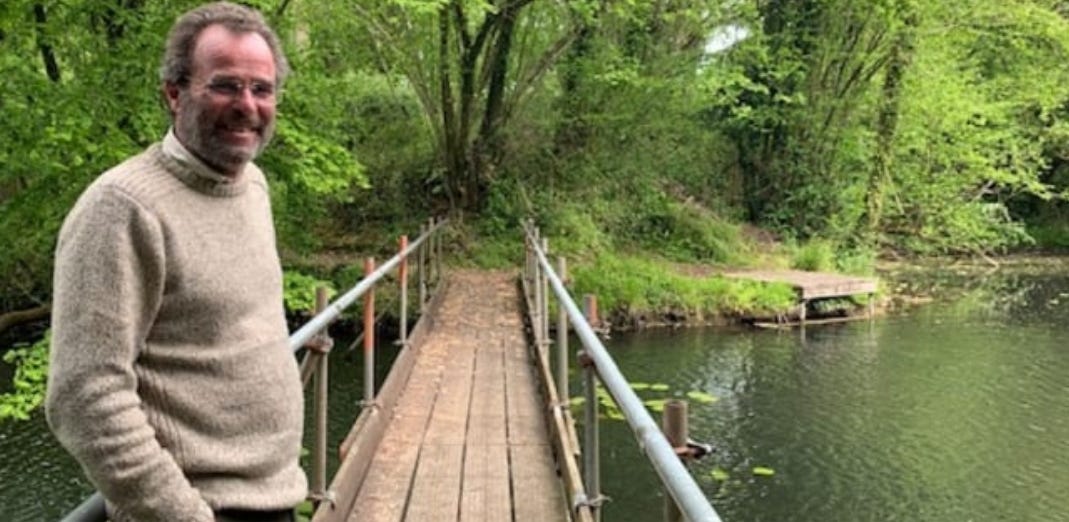
Over two decades ago, Reverend Paul Cawthorne was working as a young curate in Telford when he noticed an unfamiliar chemical smell while standing on the doorstep of the vicarage.
“It was an odd, sweet smell,” Paul told The Valleys Lead. “Having an activist bent to add to a scientific background, I thought I would find out where the smell was coming from. I made a note of the wind direction and followed the smell, which led me to a chemical dump site behind a fence. Surely, I thought, chemicals shouldn’t be coming out of this stuff.”
After doing some “homework”, Paul discovered that the site was a Monsanto (an American agrochemical and agricultural biotechnology corporation that was later acquired by Bayer in 2018) dump and that there were others like it across the UK.
As word spread that Paul was looking for more information about the Monsanto sites, a contact of his got in touch. They told him that a man who had witnessed Monsanto’s night-time chemical dumping, who wanted to speak to Paul about what had happened all those years ago.
“The man asked his boss what was going on, and the boss told him not to ask questions,” Paul recalled.
As Paul continued his quest to uncover the origins of the chemicals, he received a phone call in 2003 from a London number, later found to belong to the former UK Department of Trade and Industry. An unidentified caller warned him against digging any further.
“They said I didn’t know what I was getting involved in,” he remembered. “I was pretty scared by it.”
But his fear did not stop Paul from pursuing answers. More than 20 years later, he is still determined to get to the bottom of it.
Most recently, Paul, who featured in Michael Sheen’s documentary about industrial dumping grounds in Wales, has launched a legal challenge over the Caerphilly Council-managed site at Ynysddu: the former Ty Llwyd quarry.
The Valleys Lead has previously reported on the “toxic” quarry, including questions over why two councillors, Janine Reed and Jan Jones, were banned from the site following their repeated challenges to Caerphilly County Borough Council over the accuracy of contamination testing carried out there.
Last week, Paul filed a judicial review claim against the Caerphilly County Borough Council over its handling of the quarry.
“They’re saying it isn’t contaminated land,” he said. “They’re hiding behind a consultancy report by Arcadis. I don’t believe that Arcadis have done sufficient testing for the Council to be able to make a safe decision.”
Paul alleges that the Council’s decision in July, which concluded that Ty Llwyd did not meet the legal definition of “contaminated land”, was not supported by sufficient evidence and failed to properly apply government guidance.
He told The Valleys Lead that the testing carried out by Arcadis did not include air sampling for polychlorinated biphenyls (PCBs), chemicals associated with cancer. He also claimed that testing was not carried out for the 12 most toxic PCBs and that detection limits were set so high that the results were unreliable.
Paul said Caerphilly Council had held an Arcadis report on Ty Llwyd since October 2024 but had refused to release it.
However, following the release of Michael Sheen’s documentary Buried at the internationally renowned Sheffield documentary festival, the Council decided to publish the report. Paul suspects the timing of its release was intended to protect the Council against accusations raised in the documentary.
“Alongside changes being discussed with Natural Resources Wales, perhaps they held the report back and then they thought they should get it on file so they could hide behind the consultancy which said the land wasn’t contaminated enough to be labelled as contaminated land,” Paul said. “The potential cynicism of their tactics was obvious.”
Kirsty Luff of the environmental charity Friends of the Earth Cymru, told The Valleys Lead that the research for Buried “draws on the knowledge and expertise of specialists in this field. It also reinforced previous findings showing high levels of PCBs at the site.”
Given the findings, Friends of the Earth Cymru said it was important that the decision not to designate the Ty Llwyd quarry in Caerphilly a contaminated site is subject to further scrutiny.
In September, Paul, along with other activists and local councillors, finally felt a glimmer of hope that action might be imminent, following unanimous support at both Caerphilly County Borough Council and the Senedd for action to address contamination at various sites across Wales.
However, when Caerphilly Council subsequently wrote to the Welsh Government requesting a public inquiry into potentially contaminated sites, the response from rural affairs minister Llyr Gruffydd described land contamination as a “priority” for the Welsh Government but stopped short of agreeing to support a public inquiry.
When The Valleys Lead approached the Welsh Government, asking why a public inquiry was not agreed, we were told that the Cabinet Minister didn’t support or reject the request for an inquiry but rather pointed to how they were already looking to address some of the issues that were raised in the motion [in the Council] and how regulatory checks in place now were much stronger than those in the past.
“We know residents are concerned about contamination, and we take those concerns seriously,” a spokesperson from the Welsh Government told The Valleys Lead. “That is why we are developing a Wales-wide strategy to restore former industrial land and protect communities from potential risks. Identifying and regulating contaminated land is a matter for local authorities and we have issued guidance on how they are to carry out their duties under the Environmental Protection Act 1990. Caerphilly County Borough Council’s work to manage the Ty Llwyd site is ongoing and we are in regular contact with them to monitor progress.”
Paul had previously held off taking legal action, hoping that pre-action letters to the Council, the radio and television series examining contaminated land in Wales, and the support expressed by Caerphilly Council and the Senedd, and would prompt action from the Council and Welsh Government.
But when nothing materialised, he decided that a judicial review was the only way forward.
When The Valleys Lead spoke with solicitor Alice Goodenough, who is representing Paul, she said that the Council’s response to a pre-action letter, setting out the reasons why the Council’s decision was unlawful, denied any error of law.
“They responded to the letter, but they did not change their mind or accept what they had done was unlawful,” she said. “They didn’t respond in any depth to the detailed submissions made or send any of the information we requested. They have also failed to provide key documents demonstrating how the decision was signed off and made.”
In response, the judicial claim was filed and has now been served on Caerphilly County Borough Council. The Council has 21 days to respond from 12 November.
“The next stage is for the Administrative Court in Cardiff to look at the submissions and evidence of both parties, before deciding whether the claim is arguable,” she said. “If so, the court grants permission for the claim to proceed to a hearing.”
Paul is hopeful that the judicial challenge will result in “a quashing of the original decision that it (Ty Llwyd) isn’t contaminated land” and that further contamination testing will be carried out by a different independent consultancy which has not been assisting the Council at the site previously.
But, Paul said, this is only the beginning.
“I’ve got five other councils I want to take to court, but we decided this would be the first one,” he concluded. “Mainly because I’m outraged by Caerphilly Council’s behaviour.”
Luff told The Valleys Lead that all councils, including Caerphilly Council, “have a legal duty to identify and assess contaminated land, but they also need far greater funding, resources, and support to carry out the vital work of ensuring that the land beneath our feet is safe for people and wildlife.”
“That is why, alongside Caerphilly County Borough Council, we are calling for an independent public inquiry into contaminated land in Wales, and urgent action from both the Welsh and UK governments.”
A spokesperson from Caerphilly County Borough Council told The Valleys Lead that the Council “is aware that a Judicial Review application has been submitted” and, if it proceeds, they “would obviously robustly defend our position in this matter.”
We were also directed by the Council – for further information - to a Ty Llwyd update issued in July.