

Hello and welcome to The Valleys Lead.
I’m sure you’ve heard - council taxes have risen again. Have you had your letter letting you know how much you owe next year?
We’ve summarised the changes for you, all in one place, so you can see how your council tax rise compares to that in other local authorities in the valleys.
Before we explain the changes (which you’ll find below!), we just wanted to say thanks for joining us again this week. If you’re enjoying and/or finding these newsletters helpful and informative, we’d love you to keep joining us every week by subscribing (it’s free!). And if you want to receive our exclusive reporting in full, there is just a small yearly fee (more on that below).
We are hoping to continue to build a community of readers in the south Wales valleys, and you would be doing local journalism a massive favour by sharing these newsletters on your social media feeds, or just sending them to people you think might be interested.
Thanks for reading, and thanks to everyone who has been in touch thus far with story tips. Rest assured, if you come to me with a story, discretion can be guaranteed. We’d love you to get in touch at valleys@thelead.uk or via Bluesky or Instagram with any stories you might have for us.
If you haven’t subscribed yet, please do so below! We’d be over the moon if you financially supported local journalism by paying just a small yearly amount when you subscribe. There’s a sale on right now so seize the day!
If you want to support The Valleys Lead, it’s free to subscribe. Paid subscribers get a bit more for only £4.99 a month, or £49 a year - but we’ve got a St David’s Day treat for you as we now have 30% off if you subscribe during March. More details below.
Some our exclusive reporting will be just for paying subscribers. We don’t have ads, we don’t do clickbait and all of our reporting is done right here in the valleys. If you sign up right now, you get 30% off your subscription forever - whether you pay annually or monthly. We believe journalism done properly is worth paying for and we hope you can support us.
It’s also free to share. And it would be a hugely appreciated if you did share The Valleys Lead with all your friends, acquaintances, and colleagues. Thank you!
The Valleys Briefing
(A little round-up of some stories in brief from our valleys.)
-Four out of five local businesses in Neath feel unsupported by government, according to a survey run by Plaid Cymru’s MS in Neath, Sioned Williams. 83% of respondents said they feel they don’t get enough support from the government, and 64% said their biggest challenge was increased costs. “Small businesses have told me via my survey that they don’t get enough support, advice or information to help them flourish. Coupled with this, we know that Wales has some of the lowest levels of footfall in its town centres. I’m hearing just how tough it is for small businesses to compete against the larger businesses, which are better able to absorb increasing costs.”
-As The Valleys Lead reported recently, there is a dental emergency in the south Wales valleys. Plaid Cymru’s MS Lindsay Whittle, representing Caerphilly, asked the First Minister about this on Tuesday, explaining that 35 dentists across Wales have quit their NHS contracts in the last 12 months, 10 of them in the Aneurin Bevan Health Board ,which covers Caerphilly. “The single biggest issue raised with me by constituents is dentistry, with many being told they must go private to retain their regular dentists,” Whittle said. “For most people this is a big extra cost as they will struggle to afford, if they can afford it at all.” He asked the First Minister what the government has done to avert the growing crisis.
-Nearly £14million of Welsh Government funding will go on making coal tips in Rhondda Cynon Taf safer over the next year. RCT has the most coal tips classified as posing the highest risk. Concerns heightened in 2020, after a landslip in Tylorstown, Rhondda Cynon Taf. Some 60,000 tonnes of spoil material slid down the side of an old coal tip, entering a river. This led to the launch of a Coal Tip Safety Taskforce, external between the Welsh and UK governments.
How does my council tax rise compare to others in the south Wales valleys?
If you’re in the south Wales valleys, you’ve most likely had a piece of post through the letterbox this week (or last or next) regarding how much you owe for your 2026/27 council tax. If you haven’t had it already, prepare yourself, because you’ll owe substantially more than you did last year
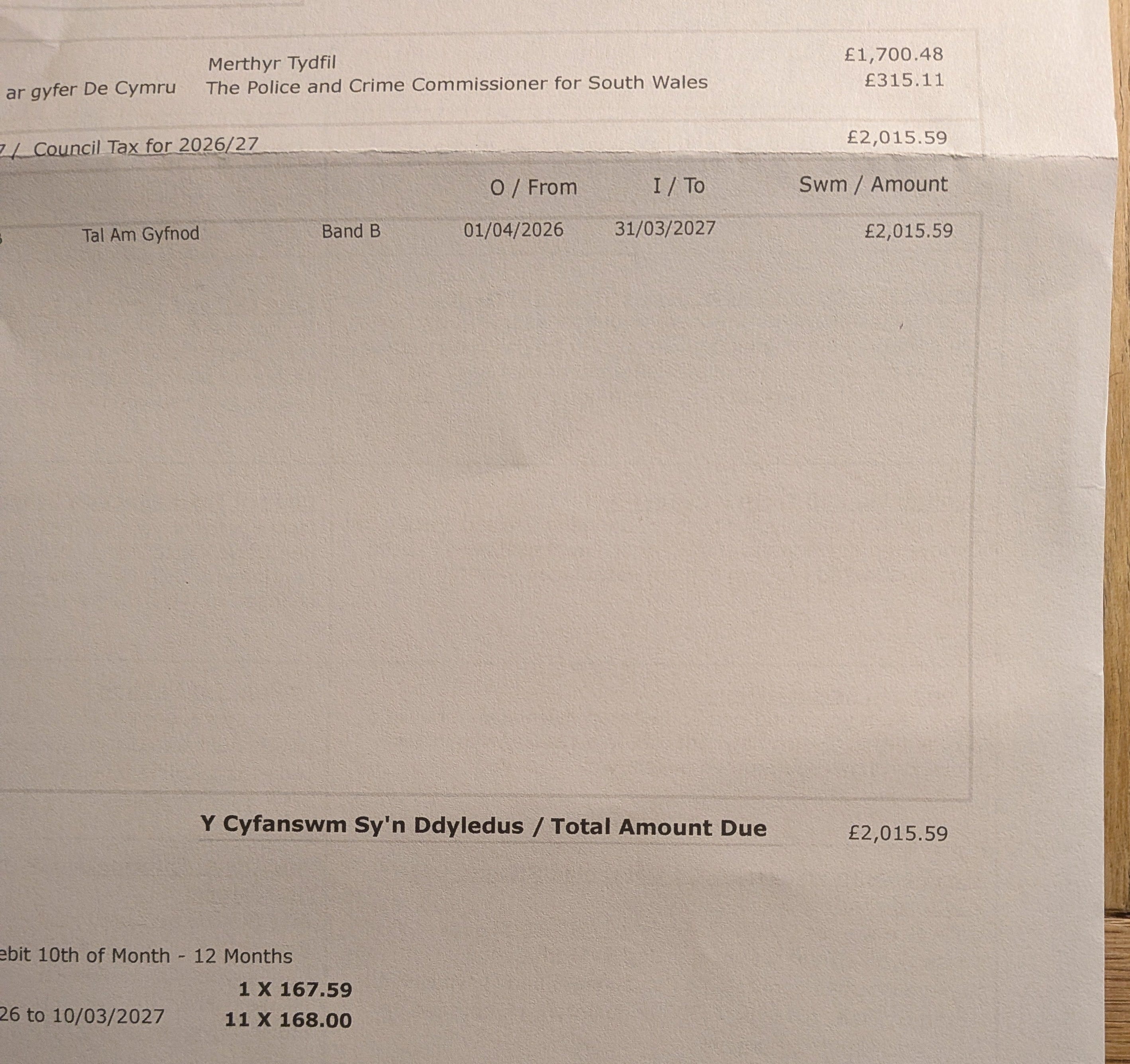
Councils get their money from three main sources: a grant from the Welsh Government, council tax, and business rates. Cash flow is used to fund a range of services including bin collections, road repairs (potholes included), education, and social care.
We’ve collated the council tax rises in each local authority in the south Wales valleys, so you can see how your tax rise compares with the rises in local authorities surrounding you.
Neath Port Talbot Council
The council tax increase in Neath Port Talbot Council for this year is 3.5%, the lowest increase in Wales.
The budget will support a wide range of services from maintaining roads and educating thousands of children to caring for vulnerable people and collecting household waste, while “keeping the council tax increase among the lowest in Wales.”
It includes an additional £7 million to support pupils with additional learning needs, alongside a further £330,000 for building maintenance, which will include improvements to school facilities.
Despite a 4.2% funding increase from Welsh Government, the council initially faced a budget gap of £16.6 million for 2026/27. However, changes to local government pension scheme contributions, alongside the identification of more than 40 savings and income generation proposals, have reduced this shortfall to £2.785 million.
Blaenau Gwent County Borough Council
The council tax increase in Blaenau Gwent has come in at a 3.75% increase.
Labour and Independent members of the Council have said that this amount was “lower than originally planned,” demonstrating a “shared commitment from political leaders to minimise the impact on households” in Blaenau Gwent.
The budget planned for will include no service cuts in frontline services, a 10% increase in school funding, and £11 million for the Council Tax Reduction Scheme.
“I’m pleased that Full Council has approved a fair and responsible budget that protects key services and reflects what residents told us was important,” Council Leader Steve Thomas said. “The 3.75% council tax rise is significantly lower than our planning assumption and is likely to be one of the lowest increases in Wales. It has been achieved through improved funding, careful financial management, and a commitment to keep any rise as low as possible in a very challenging climate.”
Leader of the Independent Group, Councillor Wayne Hodgins said that this budget “shows what can be achieved through genuine collaboration, and putting people before politics.”
Although the leaders have applauded this lower-than-expected rise, Alicia Murphy in Ebbw Vale told The Valleys Lead she is disappointed by the change, given that Blaenua Gwent is the local authority with the highest concentration of highly deprived neighbourhoods in Wales.
